The end game for guitar picks - The FingerBlade
As speed and attack increase, flat picks rely more heavily on grip and friction.
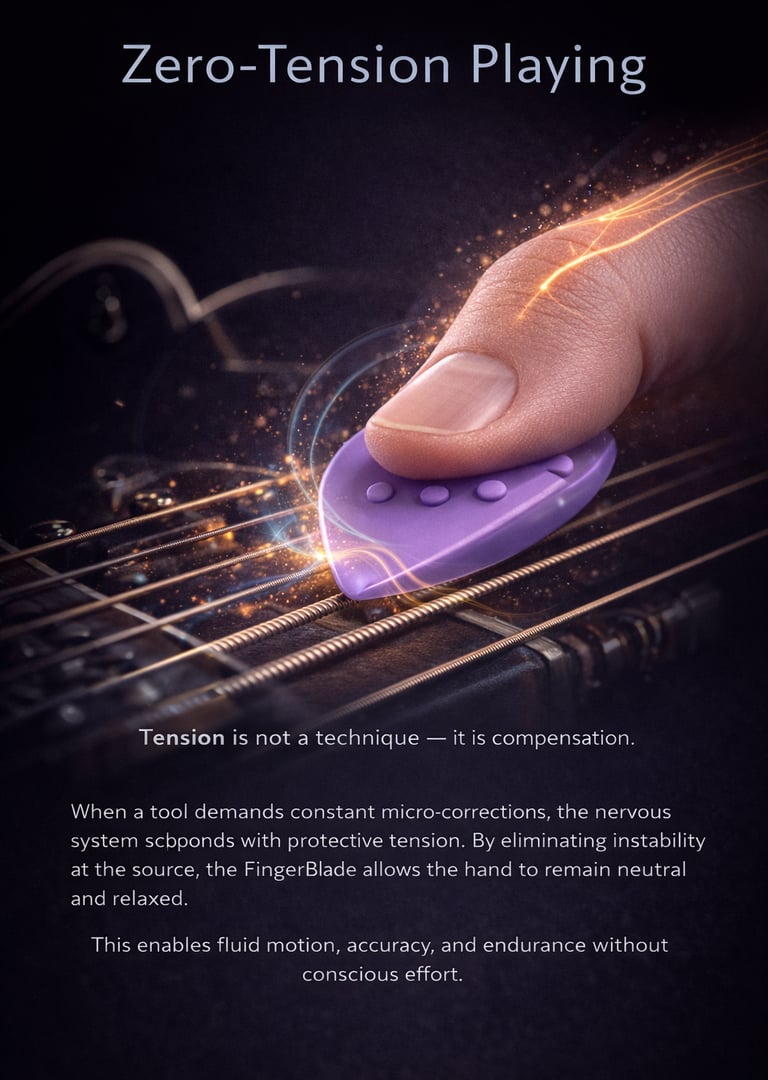
When those limits are reached, the pick slips or rotates — and the player compensates by gripping harder and making constant micro-adjustments.
This instability is not always obvious at low intensity. It appears when precision actually matters.
Tension replaces control
The harder you play, the more correction is required. Over time, that correction turns into tension.
Tension leads to fatigue. Fatigue leads to inconsistency. and eventually, it creates a ceiling on how much control
is possible—regardless of skill.
This is not a problem of effort.
It’s a problem of leverage.
The FingerBlade solves this by changing how the tool connects to the hand.
Instead of relying on friction, it creates a stable, aligned interface that stays consistent while you play. With a secure point of contact, less force is required and fewer adjustments are needed.
This isn’t about playing harder.
It’s about playing with less resistance.
It’s about letting control feel natural.
A stable interface changes the experience
See the videos:


Flat picks become unstable when precision matters