The end game for guitar picks - The FingerBlade
The Science of Feel
“Feel” is not subjective.
It is the nervous system interpreting feedback.
The FingerBlade remains precisely positioned regardless of speed or intensity. Instead of destabilizing vibration, string energy becomes tactile information the hand can immediately interpret.
The result is control without force, feedback without noise, and precision without tension.
This is not an evolution of the pick.
It is a correction of its mechanics.



A Biomechanical Interface
Traditional picks are passive objects.
They rely on friction, grip force, and constant correction to remain usable.
The FingerBlade is different by design.
It functions as an active biomechanical interface — integrating with the hand’s natural mechanics and converting string interaction into control. Instead of relying on strength or grip pressure, the system uses structure and alignment to maintain stability.
The result is a tool that works with the hand rather than against it.
This is not a refinement of the flat pick.
It is a mechanical redefinition of how control is achieved.
Engineered Control
The FingerBlade is built on a simple principle: control should come from geometry, not force.
Geometry Over Grip
Traditional picks depend on squeezing to maintain control. The FingerBlade distributes force through engineered geometry, aligning naturally with the leverage of the index finger. This allows the hand to remain relaxed while maintaining precise positioning. Instead of fighting rotation and slippage, the geometry prevents them.
The Closed Control Loop
With conventional picks, string impact creates vibration that destabilizes the pick, requiring constant correction from the hand. The FingerBlade closes this loop. When the string is struck, impact forces are redirected into stable contact points against the hand. These forces reinforce positioning rather than disrupt it, transforming vibration into feedback and stabilization. The harder the instrument is played, the more stable the system becomes.
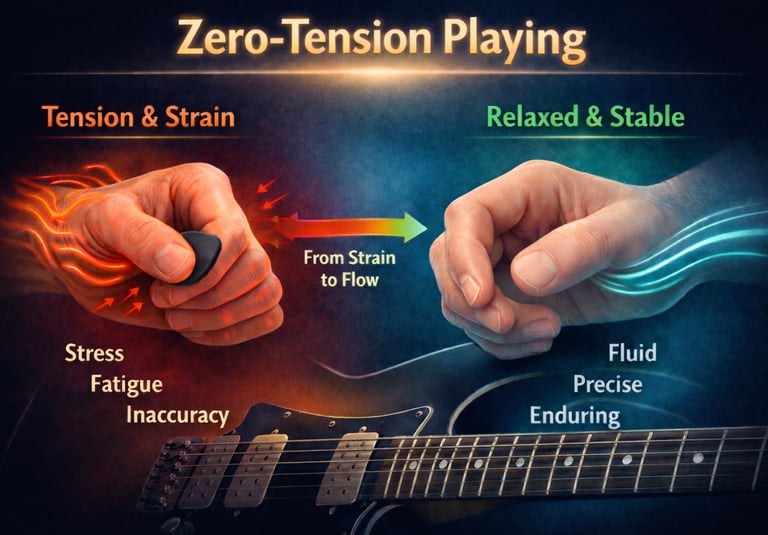
Zero-Tension Playing
Tension is not a technique — it is compensation.
When a tool demands constant micro-corrections, the nervous system responds with protective tension. By eliminating instability at the source, the FingerBlade allows the hand to remain neutral and relaxed.
This enables fluid motion, accuracy, and endurance without conscious effort.
Structural Elements
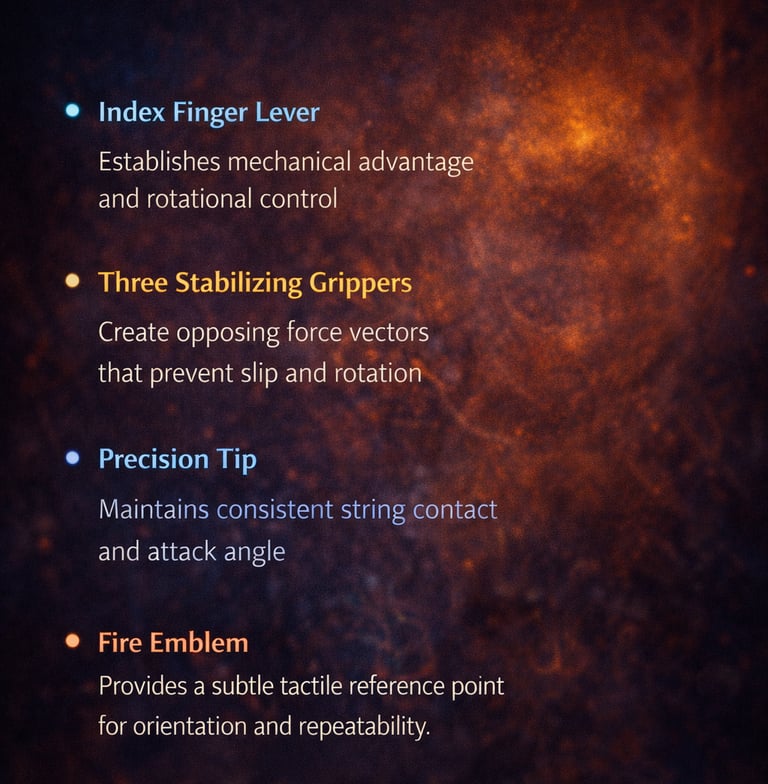
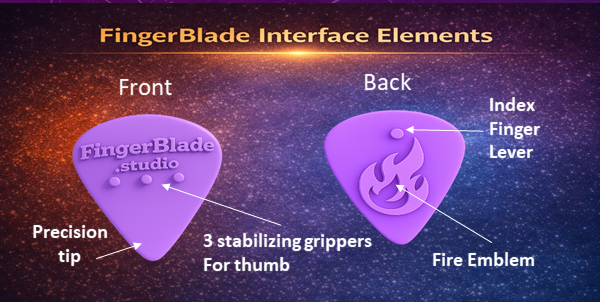
Each element of the FingerBlade contributes to stability and feedback:
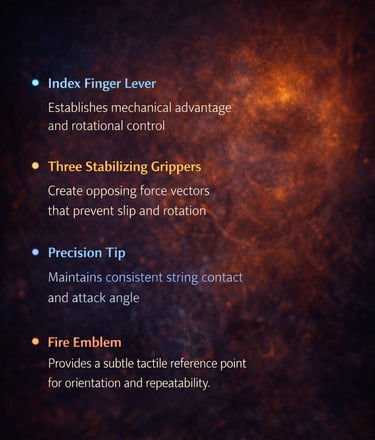
Index Finger Lever
Establishes mechanical advantage and rotational control.
Three Stabilizing Grippers
Create opposing force vectors that prevent slip and rotation.
Precision Tip
Maintains consistent string contact and attack angle.
Fire Emblem
Provides a subtle tactile reference point for orientation and repeatability.